

Can translators rebuild their field with AI?
Sharing a new project and inviting you to participate!

Hi everyone,
If you’ve been reading my newsletter, you know that I am knee-deep in figuring out how to use AI to create a better future for the workforce.
Today, I am sharing a new project and inviting you to participate!
It is about rehabilitating the translation professions, which have been hit hard by AI adoption.
In a nutshell
Translators have suffered from AI adoption consequences more than most. The impacts started with machine translation, long before the generative AI boom, but now the situation has worsened drastically. It is to the point that many are considering leaving the profession, and those who stay face severe economic pressure, loss of agency over their own work, and heightened levels of stress and anxiety, among other impacts.
That may all sound depressing, but the project I’m co-leading in is about creating a way forward.
This project is a collaboration with FIT Europe, which is a “meta-association” of translation professions: It brings together 58 European associations of translators, terminologists, and interpreters. Together, they represent roughly 40,000 professionals.
These associations are defenders of the translation professions, as their mission is to represent and promote them. That is why we are starting with helping the associations, and, specifically, their boards. Our goal is to help the associations’ boards understand how to use AI to build a new future for their professions with their communities and empower their individual members. We aim to create a shift in translation professions as a whole through the trickling down of this effort.
Work is already underway. We started with a series of workshops I gave to the board of FIT Europe, the meta-association, itself. We are now writing a position paper based on the insights from those workshops. The position paper will define a vision that will guide the creation of tools: I will teach a small group of board members from FIT Europe’s member associations to build AI tools that will make the vision we formulate a reality.
The team at FIT Europe and I would love your help!
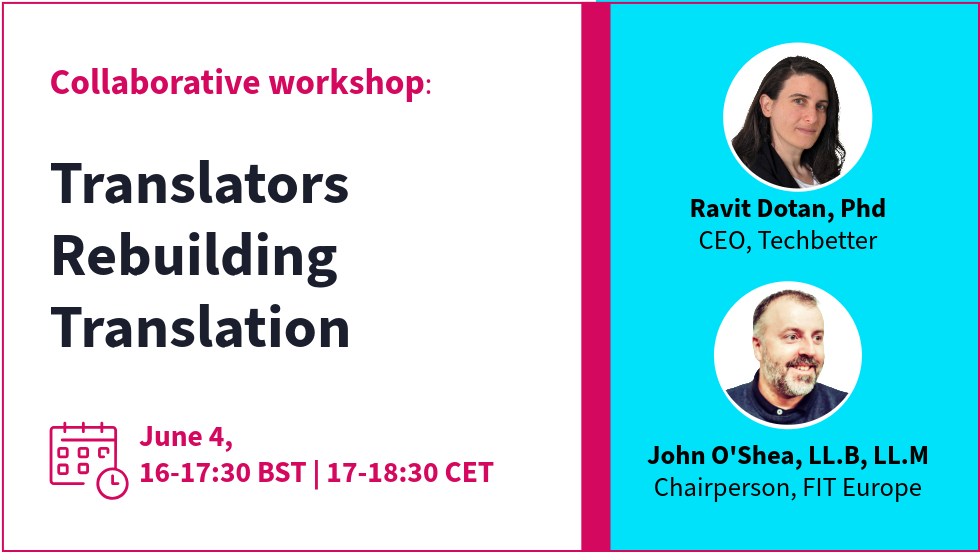
On June 4, you are invited to see and give feedback on our position paper. Register here.
This event is open to anyone interested in AI and the future of work!
What is happening to the translation professions is not unique to them. We want outside perspectives, and we think many of our insights are applicable to a broad range of professions so you will probably learn insights applicable to your domain.
In June, September, and October, I will lead the small expert group to ideate and build AI tools that implement the vision in our position paper.
Anyone on the Board of a FIT Europe member association can apply here. Only basic AI experience needed.
In November, we will present our final findings at FIT Europe’s annual meeting in Madrid.
Join us for the live collaborative workshop on June 4! Register here.
A bit about my vision for future of work
The usual story is that AI will take all of our jobs. This story misses two important points:
The finger is pointed in the wrong direction: Decisions on how to restructure jobs are made by people and organizations, not by the technology itself. In particular, decisions to use technology to translate and interpret instead of human professionals are made by people and organizations.
AI is a technology for making tools: In previous technological revolutions, workers had to start using new tools designed for them by others. The current revolution is different in that AI enables anyone to create their own tools (like chatbots, agents, and apps).
These two points are the foundation of the future I am working to create:
I want workers, in this case translators, interpreters, and others, to shape their own professional future by developing a vision about the work they want to do and then building the tools to bring it to life.
My collaboration with FIT Europe implements this approach.
A bit about the work we did so far
I started working with John O’Shea, chairperson of FIT Europe, about a year ago. At first, I helped him ideate and build tools for his own work as a translator while also critically interrogating what the technology can and cannot do. Then, in December 2025, John invited me to give a series of workshops to FIT Europe’s board.
The goal was to expand their perspective about AI and work through learning my Chef Approach to AI, which centers on thinking critically about AI, strategic focus on future work, ethics, and learning how to build AI tools. Our conversations surfaced a nuanced understanding of the devastating impact of AI on many people in their professions:
Economic scarcity - Both the 2025 and 2026 editions of the European Language Industry Survey revealed that around one fifth of respondents were thinking about leaving the profession. Many of those sticking it out face what one could describe as a grim picture: pressure to reduce rates, quick turnaround times, loss of agency over their own work, as well as heightened levels of stress and anxiety. These impacts are felt on all sides of the language industry: it’s not just the freelance professionals being impacted, language service companies are also feeling the pinch (see also: deck and recording about the 2026 report; deck and recording about the 2025 report).
Good enoughness - Accuracy is key in translation and interpreting. Yet, people nowadays seem not to be as bothered by errors, even in high stakes contexts like legal translation or medical interpreting. This may relate to a general lowering of standards as a result of learning to settle for mediocre AI outputs that are judged to be “good enough.”
Injury to professional pride - In the past, translators often felt they were in full control of the work they produced and were often seen partly as editors or even co-authors of text thanks to the depth of their contributions. Today, they are often expected merely to fix AI-generated output. This transition contributes to cheapening the profession and creates an injury to translators’ sense of professional pride.
Professional depression - all the above contributes to a sense of despair and lack of engagement across the translation community.
Despite the somewhat bleak circumstances, the board members who participated in the series of workshops said it changed their thinking on AI, leaving them feeling more empowered to wield it to rebuild their professions.
We have already started to ideate on how association boards could use AI to change the unfortunate reality and even started to build tools. For example, participants created tools to help board chairs combat the lack of engagement and motivation among volunteers and board members:
A custom chatbot to guide the members of the board of an interpreter and translator association through structured reflection about volunteering: why it matters, their current involvement, and their evolving relationship with board service.
A custom chatbot for the leaders of another association to work through leadership challenges by exploring situations, analyzing problems, and developing concrete action strategies
Our next step is to expand. We want to bring more people in because more voices are needed to get it right.
This is where we need your help.
A bit about our plan
Here is what we will do and how you can join us:
1. Contribute to our position paper
As mentioned above, the position paper articulates the realities of translation professions and enables associations to build the tools to bring about a new future for their fields. It will be the foundation for the tools we will build and will be presented at the FIT Europe annual meeting.
On June 4, we will share our first draft and invite comments in a workshop:
We will go over our conclusions and vision.
There will be dedicated time to comment on the draft.
There will also be dedicated time for discussion.
All contributors will be acknowledged when we publish.
We will also publish a companion document for contributions that couldn’t fit in the main paper, such as examples, expansions, and dissenting views.
Register here. Anyone is welcome, translation professional or not! We are very much interested in perspectives from other professions, and we think many of our insights are applicable to a broad range of professions.
2. Join our expert group
This is the plan for the small expert group I will lead to go deeper:
Last week of June - 2 meetings with the existing group to continue to ideate together based on the position paper draft and feedback.
First half of September - 4 meetings and independent work to receive my training on how to think about AI, based on my Chef Approach to AI, and how to use AI to build tools such as chatbots, agents, and apps.
Second half of September - 2 meetings to revisit the position paper given what they have learned.
Second half of September and October - The group will receive support to build AI tools to implement the vision solidified in the position paper.
Participation in the expert group is open to members of Boards of associations in FIT Europe. We can accommodate 5 new participants in addition to the group’s existing members, who are FIT Europe board members continuing from the previous phases.
Read more and express interest here.
3. Stay tuned
At the end of October, we will hold another public workshop for contributing to the position paper.
In November, we will publish the paper and present it at FIT Europe’s annual meeting in Madrid.
We hope to see you at the workshop! Register here.
And we’d appreciate it if you can spread the word to anyone interested in AI and the future of work!